
H1 2026 Performance Update


H1 2026 Performance Update
The 15 investment cases published on Global Outperformers since inception generated an equal-weighted average share-price return of 18.13% from their respective publication dates to 30 June 2026 (Q2/H1 2026), over an average holding period of 241 days.
These figures exclude dividends, currency movements and transaction costs and should not be interpreted as the return of a model portfolio. The average return remains ahead of the long-term annualised return required to achieve our 15% IRR objective.
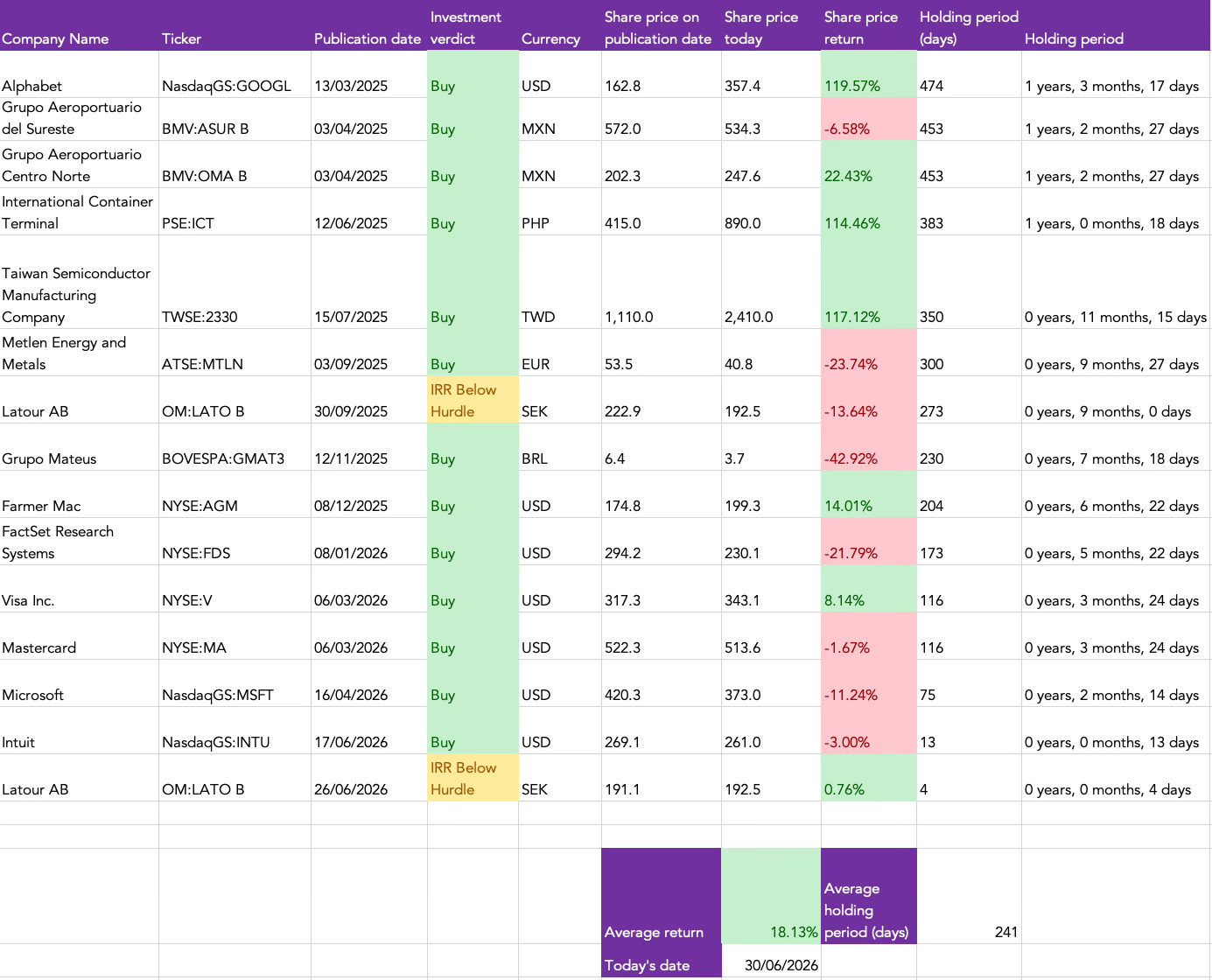
The update reviews the principal detractors and lessons from the drawdowns experienced across the published cases.
Grupo Mateus and Metlen
Grupo Mateus, a Brazilian grocery chain and Metlen, a Greek industrial conglomerate, were the two worst performers, with each dealing with business-specific issues I had underestimated at the time of our initial research.
Metlen’s power project infrastructure, now folded into the energy division, experienced significant cost overruns in 2025, leading to a steep earnings miss in 2025. Cash flow generation remained weak, adding more risk to its business case. Management has since restructured the power project division and anticipates a turnaround in 2026 with its long-term €2 billion still in place. I’m carefully watching Metlen’s debt levels today as this could break its investment case.
Grupo Mateus experienced a more difficult than we assessed retail climate, leading to below expected growth projections across pricing and store count. Inventory miscalculations announced in Q4 2025 added to its string of challenges. Although we acknowledge its challenges, 6x net earnings doesn’t reflect its growth potential.
AI exposed (FactSet Research, Microsoft and Intuit)
The main theme we focused on during the first half of 2026 was asset-light software companies with recurring and profitable earnings that seem exposed to AI at first glance. Each of these companies experienced sharp drawdowns during the period, and trade near all-time valuation lows in the case of Intuit and FactSet. We are optimistic on each of these three companies and continue to view their long-term resilience as the investment case catalyst over the next five years.
ASUR B - Mexican airport group
ASUR has operationally and share price-wise underperformed its peers. Part of the underperformance was due to currency headwinds. The US dollar depreciated by 14% during the holding period against the Mexican peso. Given ASUR’s airports are more exposed to USD international fees and the Puerto Rican airport USD exposure, it broadly suffers during peso strength. Its largest airport, Cancun, has also underperformed traffic forecasts.
However, if we account for the currency appreciation and 15% dividend paid to ASUR shareholders last year, its real returns are positive, exceeding the 15% IRR hurdle rate to date. ASUR remains in our internal Jenga IP portfolio, and we view its current 12x forward earnings as attractive.
ICTSI and Alphabet
Both ICTSI, an emerging markets ports operator and Alphabet, the world’s largest search engine provider with other technology businesses, were among the companies (and TSMC) that returned more than 100% since our publication. While we continue to hold TSMC, we now view ICTSI and Alphabet valuations above levels we view as undervalued over the mid-term and have redeployed the proceeds to other undervalued companies discussed above.
Drawdowns
An interesting observation I recently noted on companies analysed to date is that among the 15 companies, 10 of them experienced a 15-20% (or more) share price drawdown within the first few months of researching and publishing their investment case. These drawdowns are a natural result of investing in companies unloved by markets, and over time, we’ve learned to take advantage of them. A good case study is Farmer Mac.
Despite achieving a 14% return in its first 6 months, Farmer Mac shares had declined by 21% within the first three months. Farmer Mac missed its Q4 2025 EPS estimates after reporting higher-than-expected provisions for loan losses for its agricultural loans. Some might panic or cut their losses in such moments, but after revisiting our deep dive and updating our analysis, we noted no material fundamental changes and took advantage of the decline, purchasing more shares at 7x its 2026 expected net profits.
Similarly, we recently experienced a 28% drawdown in OMA B driven by market worries on challenges from the ongoing Middle East tensions on broader air travel. While there’s undoubtedly some impact here, we certainly didn’t think it was worth a quarter of its market cap and similarly added to the position during the drawdown, at 13x its forward P/E.
The recent drawdowns will not be the last. Finding undervalued companies often means investing before market sentiment improves and temporary declines are therefore an unavoidable part of the process. Future investment cases will include more detail on position sizing and the valuation levels at which we would consider increasing our exposure.