
Adobe Inc.
A deep dive and investment case


An easier to read PDF copy is available just below for paid readers.
Adobe, the world’s leading creative software company, has been a tale of two halves in the past decade. The transition from perpetual licence to subscription SaaS promised a much brighter future, business model and resilience. Investors stayed ever bullish, pushing its price-to-earnings to a record 70x P/E in late 2020.
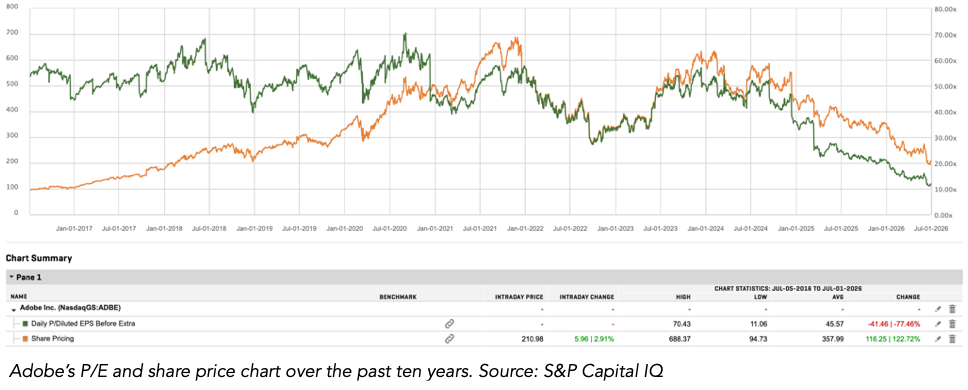
However, the same technological force that once promised more growth for Adobe now threatens its value proposition to creatives, as the most advanced software for content manipulation. The same company, once priced at 70x P/E, is now valued at 11x P/E.
I myself have also gone through two phases in my research into Adobe. I first started extremely sceptical but also eager to learn about how Adobe had lasted so long, just as we did with some other foundational five software companies like Microsoft and Intuit.
However, as I researched Adobe more deeply, poring through decades of company accounts and business history, speaking with many customers and doing general research, I gained three important insights about Adobe. First, it’s one of the few software companies with “horizontal industry standards” status. Second, there’s a key difference between “content manipulation” and “content generation”, although they meet in certain applications. Third, the power of product bundling is extremely important in valuing software companies.
Market capitalisation (As of 17th June 2026): $82.4 billion
Jenga IP 2030 FY estimated market cap: $194.2 billion
Potential IRR (including buybacks): 25.3% IRR
Jenga IP Quality Rating: 75.3/100
I will discuss these three points throughout the Adobe deep dive, but before getting into the analysis, I also want to highlight 5 key points that I believe are misunderstood about Adobe.
AI will replace Adobe: Not true. As we’ll discuss, AI and Adobe aren’t mutually exclusive and Adobe has multiple ways of monetising AI capabilities while also leaning into its trusted and secure creativity and marketing software.
Ongoing customer revolt will ruin Adobe: This isn’t the first nor second wave of customer revolt against Adobe. The same customers once outright hated and petitioned against its subscription and cloud transition. Or we can point to when Steve Jobs publicly slammed Adobe Flash. Adobe has dealt with this several times and survived.
All subscriptions are equal: Far from reality. The biggest challenge Adobe faces compared to peers like SAP and Microsoft is its subscription resilience when customers face recessions. Marketing and advertising budgets are the first to go, directly impacting Adobe’s seat count. This is the main reason Adobe should never have been valued at 70x P/E.
Figma will replace Adobe: Given that Adobe offered a quarter of its current market cap ($20 billion) to buy the creative product design startup, one might conclude Figma will soon replace Adobe. I don’t believe this is true, and as I’ll discuss, there’s a world where Figma’s collaborative app and Adobe’s fleet of design solutions co-exist.
Adobe is a one-product company: Far from reality, too. Possibly no other software company has reinvented itself as much as Adobe in the last 40 years, transitioning from the original PostScript software for publishers to over 100 current products.
Table of contents
Adobe’s history: A look into key innovations (PostScript, Acrobat, Photoshop and Illustrator) that shape Adobe’s moat today, case studies on economic recessions and the cloud subscription transition, acquisitions and the current state of its barriers to entry.
Adobe’s product suite: Insights into the Creative Cloud products and plans, document tools for Acrobat and the marketing software solutions. Insights into their competitive landscape, contribution to the Adobe ecosystem and customer persona analysis.
The creative and marketing software industry: Analysis of the raster image and vector editing markets, broader desktop publishing and the customer experience market. Insights into generative AI tools and the all-in-one product design market.
Adobe’s AI challenge and opportunity: An assessment of the current state of Adobe’s AI threats, insights into Adobe Firefly’s business model and value chain, customer use cases and growth of AI-generated media content and a comparison of Adobe’s competitiveness relative to Google and OpenAI.
Adobe’s business economics: An overview of Adobe’s revenue by segments (digital media, digital experience and publishing and advertising), revenue by customer group (creative & marketing professionals and business professionals & consumers), revenue by region and an analysis of its cost structure and profitability.
The growth potential: A discussion on Creative Cloud’s user growth, pricing mix and Firefly monetisation, Acrobat’s user growth, marketing solutions customer cross-selling opportunity and potential acquisitions.
Adobe’s risks and challenges: Further discussion on Adobe’s AI challenge, state of its pricing power, management challenges, exposure to economic challenges, churn and the competitive climate.
Adobe’s valuation: Adobe’s net earnings and free cash flow projection to FY2030, valuation analysis and IRR projections over the next 5 years.
Conclusion: Final thoughts on the AI disruption to software companies and my portfolio management approach with software companies.
1. Adobe’s History
“Technology is never created in a vacuum. If you’re working on it, then someone else is too. The only way to succeed is to get there first.” - Charles Geschke, Adobe’s co-founder.
Every investment analysis I make starts with two questions. First, if given $1 billion in cash with a team of the brightest Silicon Valley technology talents, how easily can you replicate the product, value proposition and win their customers? The second question is, if the world’s most innovative companies (Google, Apple and Microsoft) were interested in your industry, how easily can they erode your market share?
Luckily and unluckily for Adobe, they’ve had to face the reality of both questions over the last 40 years. Figma, an indirect competitor in the collaborative product design industry, raised over $1 billion. At the same time, Apple, Microsoft and Google each compete with different Adobe products, and in many cases, offer customers a free version as an alternative.
For the second time since going public in the early 1980s, there’s a deep worry among market participants about the outlook for Adobe, its survival and future prospects. To make the case for Adobe’s resilience in today’s AI world, we must first study its history through the lens of four products that shaped Adobe as it is known today. These are PostScript, Portable Document Format (PDF), Photoshop and Illustrator.
PostScript (1983)
A technology challenge in the wake of the PC revolution in the early 1980s was printing. Printers and computers spoke different languages, which meant formats and fonts changed depending on the printer used. Adobe’s co-founders, John Warnock (later its CEO) and Charles Geschke (its COO), initially developed a solution while working at Xerox’s PARC, but difficulties with getting internal approval for their commercialisation forced them to start a new company, Adobe and develop the PostScript software. Rather than simply reprinting in pixels, PostScript used mathematics to instruct printers, ensuring shapes, fonts and formats were maintained regardless of the printer used.
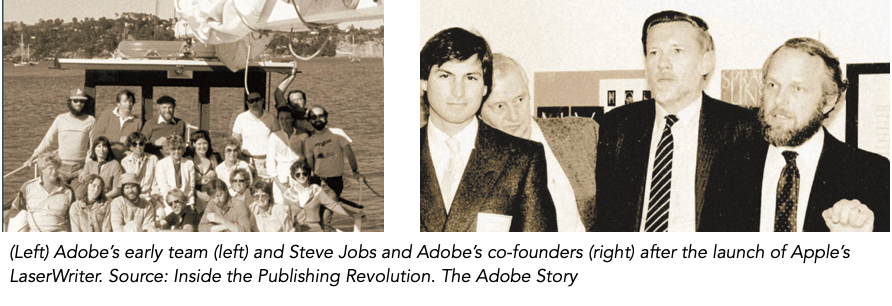
The nature of a ‘standards business model’ where one product sets the approach for the whole industry means there’s a real first-mover advantage, and after considering different business models, an investment from Apple and Steve Jobs, alongside a license agreement for 5% of sales from Apple’s LaserWriter printers, Adobe settled on a royalty business model which turbocharged its revenue from day one.
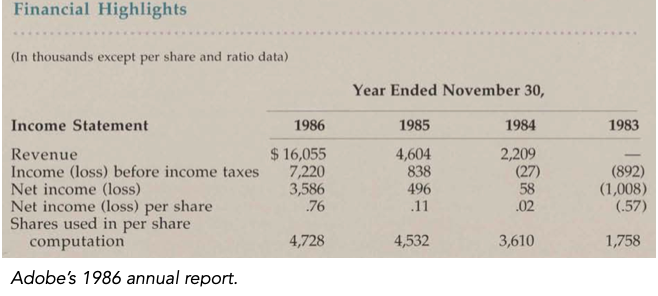
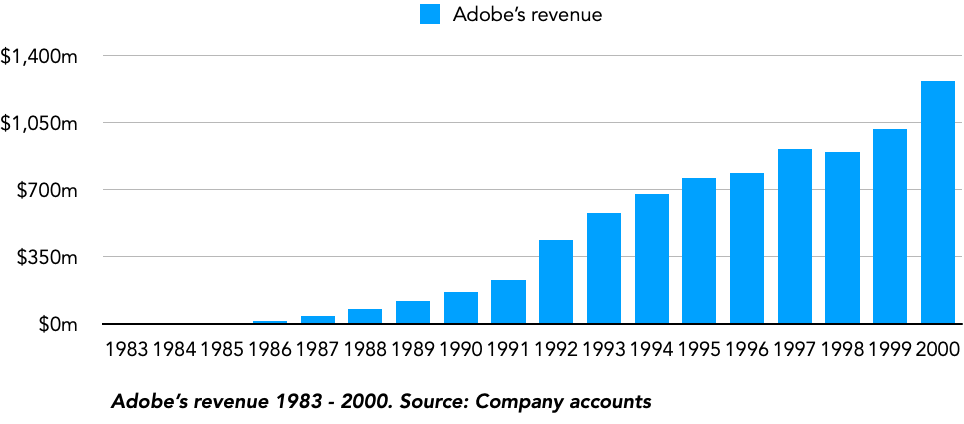
Adobe was already profitable in its first full operational year in 1984, with revenue growing from $2.2 million to $16 million in two years (see image above). Competitors like Xerox’s Interpress (created by Adobe’s co-founders while at Xerox) and Imagen, then utilised by HP, meant Adobe knew it needed to grow fast and decided to go global, starting with an agreement with Morisawa in Japan for its fonts business, where customers similarly paid for licenses to install Adobe’s fonts.
Had Adobe stopped innovating here, it would have become another failed startup. Today, PostScript itself is immaterial to Adobe, sitting within the publishing and advertising division, representing less than 1% of Adobe’s revenue. However, it led to a pivotal transformation: the creation of the Portable Document Format (PDF) and Illustrator.
Illustrator (1985)
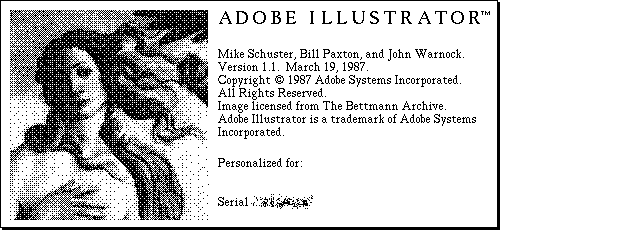
John Warnock, one of Adobe’s co-founders, noticed that his wife, Marva, a graphics artist who later designed Adobe’s initial logo, had work that paralleled PostScript’s technology and thought of extending the technology to the design world. To achieve this, he recruited PostScript engineer Russell Preston Brown and some in-house designers to develop the Illustrator software, launching in March 1987 for $495.
Scepticism from the design world was initially high, and Illustrator faced competition from CorelDRAW and FreeHand by Aldus (Adobe would later acquire Aldus in 1994), but over time, especially after Microsoft and Apple launched their partnership, ‘TrueType’, commencing the font wars in the process, Adobe’s diversification efforts were rewarded.
During the Seybold Seminars trade show, when Bill Gates announced the TrueType partnership to curb Adobe’s font monopoly, John Warnock responded at the event:
“The biggest bunch of garage and mumbo jumbo…We are going to out-invent the bast***d”
Just as Adobe continues to diversify beyond the Creative Cloud division today, its priority in the early 1990s was diversifying from PostScript and its font royalties and then a recent recruit, Fred Mitchell, identified the software application market as the main strategy.
Photoshop (1990)
“I ran, not walked, to Mr Warnock’s office and said, ‘We should buy this [Photoshop].” Inside the Publishing Revolution
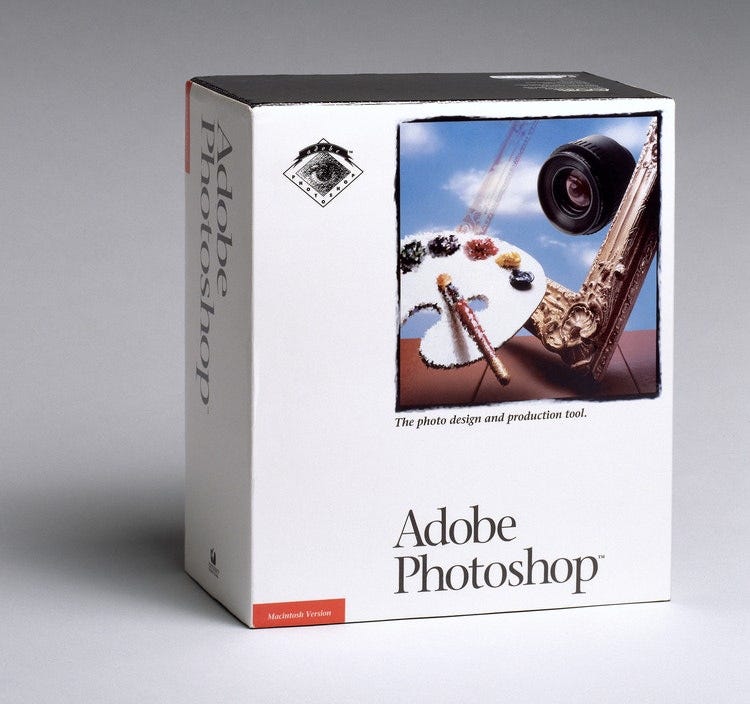
Unlike PostScript and Illustrator, Photoshop wasn’t created internally at Adobe. Fred Mitchell came across the Knoll brothers, who developed Photoshop during Thomas Knoll’s PhD thesis. Unlike Illustrator, which was built on vector-based editing and enabled artists to draw line art from scratch, Photoshop enabled photographers to work on images from other sources.
Although optimistic, Adobe, like many others, underestimated the success of Photoshop and had bought Photoshop via royalties on units shipped. As time proved, significantly more people capture photographs than draw vectors, and in less than two years, Photoshop overtook Illustrator in sales, and then launched on the Microsoft Windows OS.
Over the next few years, Adobe acquired and established other products. One among these that remained influential for decades was Acrobat, an application for creating and viewing documents in the PDF file format.
Portable Document Format (1992)
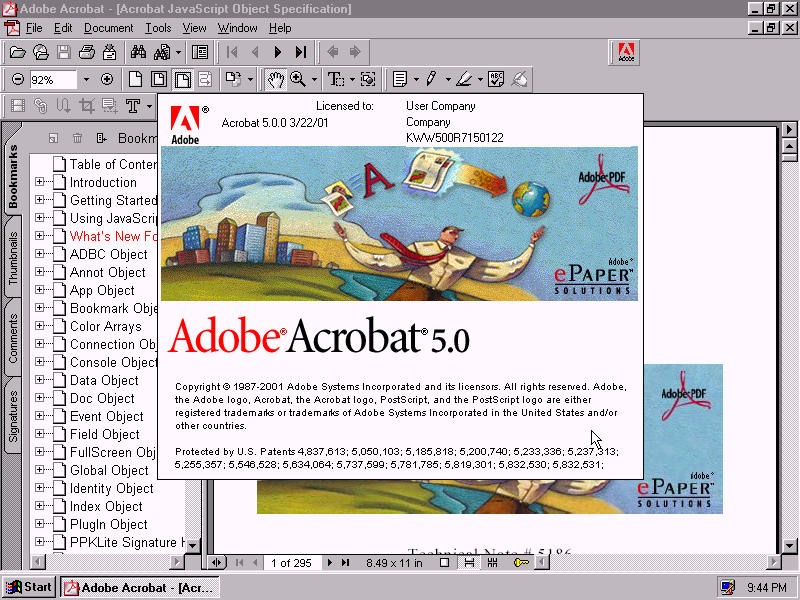
Building on PostScript’s technology but with varying technical differences, Adobe diversified into solutions for the paperless office. Codenamed “Project Camelot”, the PDF brought an alternative text file format, allowing users to engage with an uneditable, mailable and printable document. Unlike PostScript, though, the PDF itself wasn’t initially monetised, and a year later in 1993, Adobe created Acrobat, a software application targeted to businesses for viewing these PDFs.
Unlike the other applications, Acrobat and the PDF were slow to gain traction, and it wasn’t until the internet that its growth accelerated. Early adopters like the U.S tax IRS for tax returns, advertising agencies, the Associated Press Online Service and then later financial institutions with the Acrobat 4.0 release in 1999 spurred the initial rise of PDFs.
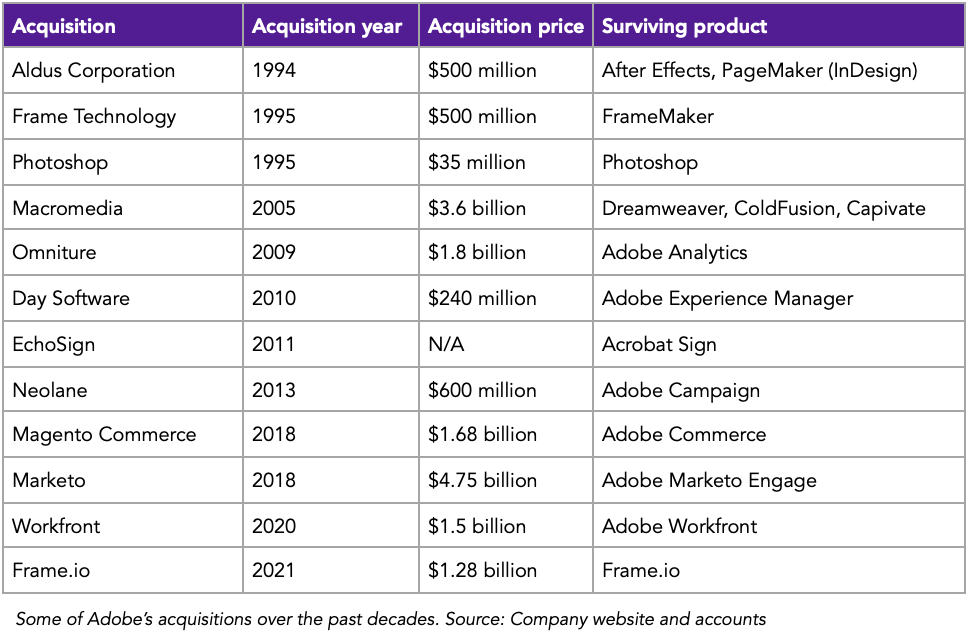
Today, these four products gave rise to Adobe’s digital media division (76% of revenue) and to complement them, various acquisitions like Aldus Corporation in a stock swap deal then valued at $500 million in 1994 consolidated Adobe’s position in desktop publishing. Today, Adobe’s InDesign and After Effects, two niche creative products, still contribute to the Creative Cloud offerings.
Acquisitions remained a key part of Adobe’s business strategy, and rather than simply empire-building, most acquisitions played important roles in shaping Adobe’s product scope today. The table below highlights 12 major Adobe acquisitions and their surviving products. As you can see, even products acquired 30+ years ago remain integral to Adobe’s ecosystem.
Although the history recap above simplifies the Adobe story during its initial years, the period was broadly positive for Adobe, despite the challenges from Apple, Microsoft and many peers in desktop publishing. Adobe’s revenue and operating profits grew every year until 1996, when there was its first profit slowdown, marking the first competitive threat: the internet.
Test of time case study 1: The internet (1995 - 2002)
“At the peak of the internet bubble we were on the outside looking in.” Bryan Lamkin on Adobe
Every new technological shift poses some threat to existing technology leaders, and similar to AI, investors questioned if Adobe could survive the internet age, with its shares falling by 61% between December 1995 and September 1998. At that time, Adobe was already a major software company, only behind Microsoft in market share and was the 6th most profitable publicly listed software company.
Compared to Microsoft, though, Adobe was less prepared for the internet, which attacked its business on all fronts. Two, however, stood out: product relevance and employee morale.
The internet posed a direct threat to Adobe’s PDF as HyperText Markup Language (HTML) increasingly became the standard for web publishing. As HTML grew, Acrobat struggled, and despite attempts to enter the HTML design market with PageMill, it wasn’t until its partnership with Netscape’s web browser that PDF users could click web links directly on PDF documents that Adobe curbed PDF’s relevance loss.
Arguably the more critical challenge was the lack of employee morale. As Adobe’s shares fell while startups sprang up with attractive stock options for employees, Adobe employees became frustrated with internal growth, leading to lots of infighting. To deal with this issue, Adobe’s co-founders concluded that turning Adobe into a lean organisation was the best solution. They created a new team led by its eventual CEO from 2000 to 2007, Bruce Chizen, who in turn assembled a new team led by Shantanu Narayen, Adobe’s current CEO.
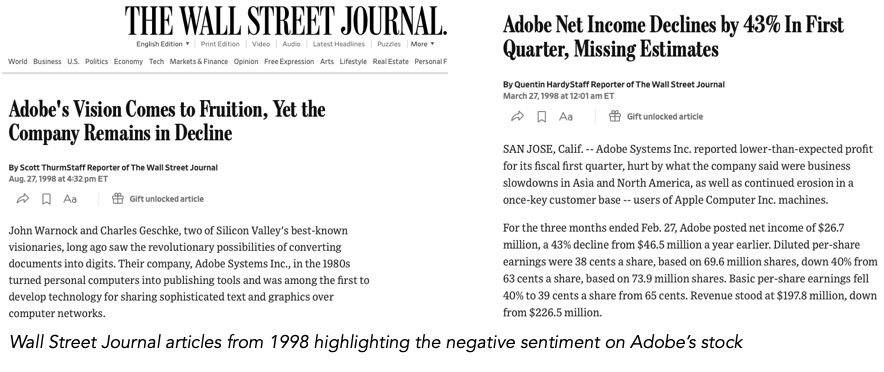
With its more focused organisation and clearer strategy, Adobe doubled down on its approach to new technological shifts, which was centred on (1) adapting existing products to new technologies, (2) using acquisitions to support adoption and stickiness. Acrobat was a good case study of this. After years of being offered as a free version, the internet unlocked a monetisation path for Adobe, and by 2001, Acrobat became the standard tool for enterprises, representing 24% of Adobe’s revenue. As of 2000, two challenges Adobe hadn’t yet faced were management change and surviving a deep recession.
Test of time case study 2: Management change
Another key sub-category within test of time is surviving the founder transition. Until 2000, Adobe was led by its two co-founders, and when founders step back, it’s often common for key employees to similarly resign, morale to decline and for the company to lose its product and forward-looking visionary leadership.
Although Bruce Chizen had worked at Adobe since the 1994 Aldus merger, he was very different from his predecessor. Unlike John Warnock, Bruce lacked a technical background, but as he often mentioned, his role was to inspire his engineers, rather than create products himself.
Although I always prefer technical leaders as CEOs of technology companies, Bruce Chizen’s successful 7 years as its CEO proved it could outlive its co-founders. During the period, Adobe began bundling its creative tools into one package, the Creative Suite, starting with Photoshop CS. Ever paranoid about competition as a company, Bruce acquired Macromedia, eliminating the threat of market share loss on the web as Macromedia’s Flash, used to create web videos and games, proved dominant, although short-lived.
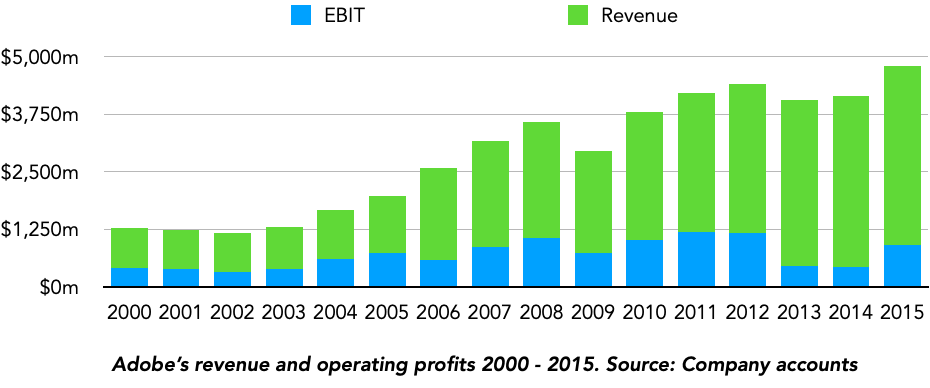
During his seven years as CEO of Adobe, revenue grew by 14% annually while operating profits grew by 11% annually. Perhaps the even more successful management transition was from Bruce to Adobe’s current but now departing CEO, Shantanu Narayen, an Adobe veteran since 1996.
“I’m not leaving under any cloud. There’s no severance agreement. I’m taking a break, and the reason I feel comfortable taking a break is because the company is in such good shape” - Bruce Chizen, on leaving Adobe in 2007.
Test of time case study 3: Financial crisis
Beyond the technological disruption risk, Adobe’s other major business risk and challenge is its product demand sensitivity to the broader economic and business climate. Here’s an excerpt from its 2003 annual report:
“The Creative Professional market is sensitive to the economy, as most users of Creative Professional software products derive their revenue mainly from corporate marketing and ad spending in corporations. In difficult times, corporations tend to reduce marketing spending.” Adobe 2003 annual report.
23 years later, this challenge hasn’t changed and remains a problem, and in my risk analysis (section 8) I discuss more broadly how I account for this today.